Special Topics
- A Reason that Messiah Doesn’t Come Earlier According to Kol Hator, Which Was Written by a Disciple of the Vilna Gaon
- Why the Holocaust ?
- Torah Codes by Professor Daniel Michelson
- Mike Huckabee & Friends Are Trying to Convert Jews to Follow the J-Man – Here is an Anti-Missionary Response
- Monotheism Vs. The Outlook That Everything is G-d
An Article Against The Attempt To Deify The Rebbe Of Lubavitch, Rabbi Menachem Mendel Schneerson - Issues Involving The Ascent To The Temple Mount – An Exchange Of Letters Between S. Scheinman and Rabbi Avigdor Neventzal
- The Location of the Temple on the Temple Mount and Other Temple Related Issues
- Argaman – An English version of the halachic article that appeared in Techumin, Vol. 26
- Did Maran, Rabbi Avraham Y. Kook also follow the Kol Hator Approach to the Temple Mount and the Temple? Authored by Shlomo Moshe Scheinman
- When Is It Permitted to Bow to Men and When Is Bowing Forbidden Intermediary Worship , According to Rabbeinu Nissim
- The Future Borders of the Tribes of Israel as Evidence for the Size of a Cubit
- Video by Oren Evron: The Code of Creation, An Awesome and Inspiring Mathematical Code Is Revealed in the First Verse of the Torah
You are invited to visit our blog home page at https://vilnagaon.org/blog/ Below is a sample of our blog posts.
And Hashem said, “Shall I conceal from Avraham what I am doing? etc. For I have known him in order that he may command his children etc. and they shall keep the way of Hashem.” — Rabbi Moshe Zuriel zt”l, Derishat Tzion, Parashat Vayera

[A] When the Holy One, blessed be He, decided to punish the inhabitants of Sodom and to destroy the city from the face of the earth, it is written: “And Hashem said, ‘Shall I conceal from Avraham what I am doing? etc. For I have known him in order that he may command his children etc. and they shall keep the way of Hashem’” (Genesis 18:17–19). And why was it necessary to inform him? Rashi’s grandson (Rashbam) answered: “Shall I conceal from Avraham what I intend to overturn in Sodom? And I know that his children will keep the way of Hashem and will merit bringing upon them what [Hashem] spoke to Avraham—to give them the land of Canaan. And these towns are part of the inheritance of his children, as it is written in the boundary of Canaan in Parashat Noach (10:19): ‘And the border of the Canaanite was from Sidon as you come to Gerar, as far as Gaza; as you come to Sodom and Amora (Gomorrah), Admah, and Zeboiim, as far as Lasha.’ So how could I destroy his land, or the land of his neighbors, without his knowledge?”
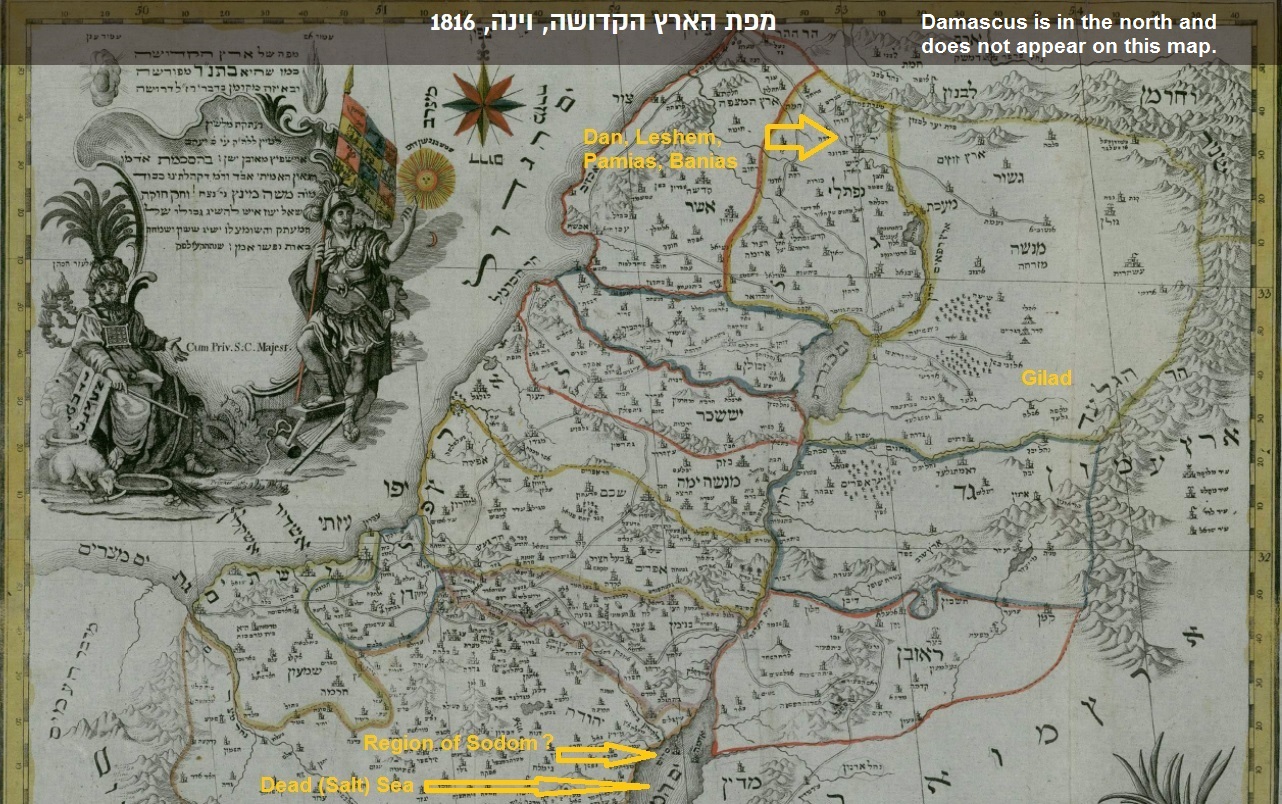
[B] Among the Ba’alei ha-Tosafot is Rabbenu Yosef Bechor Shor, who added to the above words of Rashbam and brought support from the continuation of the verse (v. 18): “And Avraham will surely become a great and mighty nation,” etc. His words are: “That is to say, I have given this land to Avraham, and now I wish to destroy these cities that belong to him? How could I conceal it from him without his knowledge? And if you say that nothing is lost to him in this, for the land is broad enough for him and his seed? Therefore it says [that this is not so]: ‘And Avraham will surely become a great and mighty nation,’ and the entire land (is needed) [will be needed] for him. Therefore it is not for him to destroy without his knowledge. And He revealed it to him and obtained his consent, that if there are not ten righteous people there, He should destroy [the place]—and so He did. And afterward Avraham could no longer complain, for it was done according to his own words.”
The permanent location of this post is located at: vilnagaon.org/informing-avraham/
For Blog Home page or to search the blogs, press here
 Web Site Home Page
Permanent Topics
Book 2: Interpretation of the Bible
- Messianic Movements That Failed
- False Prophet
- The Tradition
- The Mitzva To Appoint Judges and Officials to Enforce the Law
- Let Us Make Man… (Genesis 1:26)
- The Man That Blasphemed
- Resurrection of the Dead
- Most of The Prohibitions of The Bible Do Not Apply To Gentiles
- Was It a Mitzvah [Good Deed] Or a Sin Not To Kill King Sha’ul {Saul}? – Part 1
- Was It a Mitzvah [Good Deed] Or a Sin Not To Kill King Sha’ul {Saul}? – Part 2
- The Task of the Spy, Eli Cohen, H”YD. – A Torah Hint About This
- Why the Bible is Immune to Scientific Criticism
- The 430 Year Gap
- Biblical And Historical Precedents For Resisting Army Service
 B”H Excerpts from An Anthology of the Gaon by Rabbi Moshe Zuriel {Tzuriel}
A Selection of sayings of the Vilna Gaon regarding beliefs, extracted from most of the writings of his disciples, of those faithful to him, and from some of his own writings.
Swiftness
The fact that a person puts off performing a mitzvah until the morrow leads to his not performing it at all, rather, as soon as he has the opportunity he should immediately perform it – to Proverbs 10/8, 14/23, 27/1
If not now, then when?” (Avot I) – the Sages did not say ”if not today”, for even on the same day, one should already now, perform the mitzvah.- to Proverbs 6:9
This Anthology of the sayings of the Vilna Gaon is Not Appropriate For Non-Jewish
Souls. Instead they should scroll up this page to the section A Light Unto the Nations which is more appropriate for a mixed audience.
Anthology Topics: 1 Cruelty 2 Erev Rav 3 Father 4 The First Man 5 Forefathers 6 Heretics 7 The Holy Temple 8 Limbs 9 Love of G-d 10 Man 11 The Nations of the World 12 Prophecy 13 Reproof 14 Reward and Punishment 15 Suffering 16 Swiftness 17 Torah 18 Torah Study 19 The World to Come
–B”H
| Tekhelet Has Been Rediscovered ! For more information on how to get Tekhelet and why you should wear it, GO TO: http://www.tekhelet.com Here at https://vilnagaon.org/ we also have an article about Tekhelet by Shlomo Moshe Scheinman (the author , in the past has written articles with the Haskama of prominent Rabbis , such as, the author of Otzrote Haraaya, Rabbi Moshe Zuriel (Tzuriel) and Rabbi Yisrael Ariel, head of the Temple Institute, מכון המקדש.) |